Silence Has a Shape: The Unseen Sound Work Behind a Dance Show
When a dance show arrives at a new venue, the first thing the company often checks is not the floor or the lighting rig. It is whether the room will let the sound behave. A low ceiling can swallow a cue. A high, curved ceiling can send it back late. A dead black-box space can make a recorded breath sound like a secret, while a resonant hall turns the same breath into a rumour. For a touring dance company, sound is never just the music. It is the air between the moves.
The First Note Is Often Nothing
In the studio, a choreographer and a sound designer tend to start with a shared question: what should the audience hear first, and what should they not hear yet? That second half matters more than people think. Silence in a dance show is not an absence of work. It is a designed surface. It gives weight to a landing, makes a breath audible, and turns a pause into a decision.
A useful way to think about it is that silence has a shape. A three-second gap after a lift feels different from a seven-second gap. The same gap placed after a fall lands differently again. Sound designers often talk about cue timing in the same breath as choreography because the two are doing the same job: controlling when the audience notices something.
This is where the collaboration gets interesting. A choreographer might ask for a sound cue to land on a particular count, then discover in the room that the cue works better a half-beat later, once the dancers have exhaled. The sound designer might suggest pulling a layer out entirely so the floor noise can do the work. Nobody is being precious about the original plan. The plan was only ever a way to start listening.
Speaker Placement Is Choreography
On tour, speaker placement is not a technical afterthought. It is staging. Put a speaker upstage and a whisper seems to come from inside the dance. Put it downstage and the same whisper feels like it is addressing the audience directly. Put two speakers slightly out of sync and you get a strange, elastic sense of space that can make a simple walk look uneasy.
A UK dance company building a show for mid-scale theatres and community venues has to plan for wildly different rooms. A piece that relies on a delicate front-of-stage speaker might need a different balance in a village hall with a low stage and a hard back wall. The sound world has to travel, which means it has to be robust without becoming generic. The solution is usually not more equipment. It is clearer priorities: which three sounds must always be heard, which two can be flexible, and which one can disappear if the room refuses to cooperate.
Floor Noise Is Not a Mistake
Dancers are often taught to land quietly. On stage, a quiet landing is a choice, not a default. Bare feet, soft shoes, socks and trainers all make different textures on different floors. A sprung stage has a particular low thump. A lino-covered community hall can squeak. A raked stage can turn a slide into a scrape.
Rather than treating these sounds as problems to be hidden, sound designers sometimes fold them into the score. A repeated brush of foot on floor can become a pulse. A landing can become an accent. The audience may not consciously register it, but they feel the difference between a show that is floating on top of its music and one that is physically inside it.
For performers, this is a useful shift in attention. You are not just dancing to a track. You are dancing with a room, a floor, and a set of speakers that are all making noise whether you plan for it or not.
What Dancers Can Practise
Listening on stage is a trainable skill. It is not just about hearing the music. It is about hearing the space and the people in it.
Try this in the studio: run a phrase with the music at a comfortable volume, then run it with the music much quieter. Notice what you start to hear. Your own breath. The person next to you. The gap before a cue. Then run it with no music at all and keep the same timing. Most dancers discover that the phrase has a rhythm they had been outsourcing to the track.
Another practical habit is to mark cue points in your body, not just in your head. A cue is easier to catch if it is tied to a breath, a gaze, or a weight shift. If you are waiting for a sound to start a movement, you are already late. If you are already moving when the sound arrives, you have somewhere to put it.
Finally, ask questions. If you are covering a role or joining a touring company, ask the stage manager or sound designer where the speakers are and what the key cues are. Ask what happens if a cue is late. Ask what you should do if you cannot hear something. The answers are usually simple, and they make you easier to work with.
From Studio to Touring House
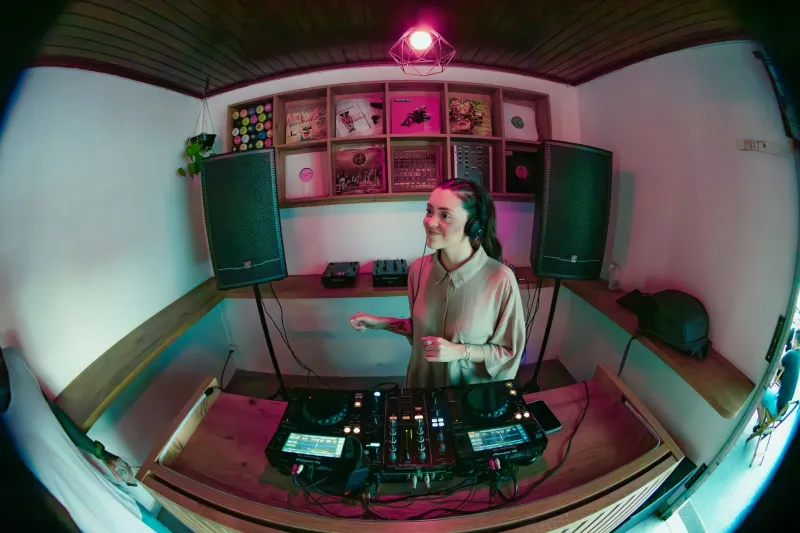
The unglamorous truth is that a lot of sound design happens in rooms with bad lighting and a laptop on a chair. A cue is built, tested, adjusted, and then tested again in a different room with a different acoustic. The version the audience hears on opening night is often the fourth or fifth attempt at the same three seconds.
That is not a failure of planning. It is the work. A dance show is a live event, and sound is one of the livest things about it. The step you cannot see is often the one that makes the movement make sense. When it is done well, you do not notice the mechanism at all. You just notice that the room feels different when the dancers are in it.