Ten Everyday Things, One Movement Language: A Devising Class Without a Playlist
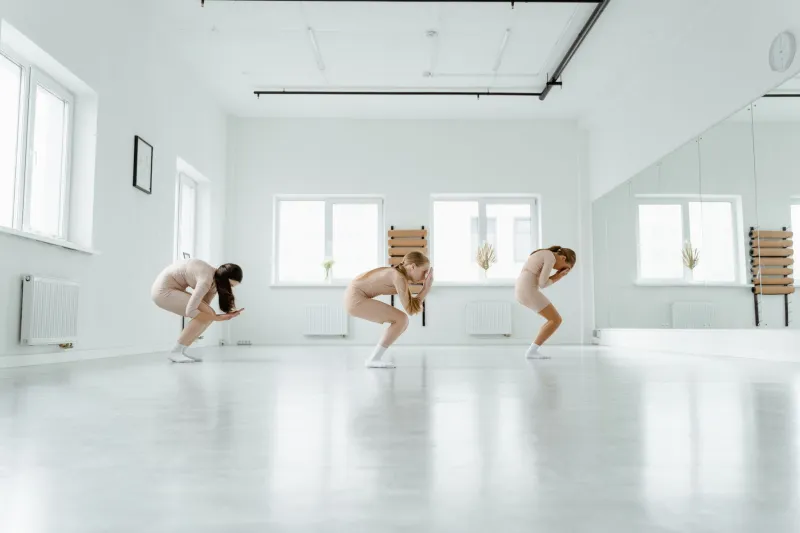
Most dance classes have a soundtrack. A track comes on, the room fills with rhythm, and bodies start to agree with the beat. That is useful. It is also very safe. Music can make choices for us: it sets the tempo, suggests the mood, and quietly tells dancers when to start and stop. Take it away and something else has to happen. Attention moves into the body, into the space, and into whatever is sitting on the floor beside you.
This exercise is built around ten ordinary objects. Not props in the theatrical sense, and not a test of mime. Just things: a shoe, a mug, a scarf, a broom, a cardboard box, a stone, a phone, a key, a folded newspaper, a chair. The aim is to let each object propose a movement question. What does it weigh? How does it sound? What shape does it make? What does it want you to do with your hands, your feet, your breath, your timing?
Why leave the playlist at home?
Object-led improvisation is not anti-music. It is pro-choice. When the music is not the boss, dancers have to make decisions from texture, weight, rhythm and spatial relationship. That can feel awkward for the first ten minutes — and then it often becomes strange, specific and much more interesting than a familiar groove.
For teachers, it is also a practical way to level a room. Dancers who feel confident picking up choreography quickly may find themselves thinking more slowly and curiously. Dancers who are quieter in a technical class often blossom when the task is about observation and invention. The object gives everyone something to look at that is not the mirror.
The exercise at a glance
Who it’s for: contemporary dance classes, youth companies, improvisation sessions, choreography labs, and anyone with a studio floor and a collection of everyday things.
Time: 60–90 minutes, depending on group size and how much you want to discuss afterwards.
You’ll need: ten objects per group or per dancer, a clear floor, notebooks or phones for notes, and no requirement for music. If you want sound, use ambient room noise or a single low drone — nothing with a strong beat.
Step by step
1. Gather ten objects
Ask each dancer to bring one or two objects from home, or build a shared pile in the studio. Aim for variety: something soft, something hard, something noisy, something awkward to hold, something with a smell, something that folds, something heavy, something almost weightless. A biscuit tin, a reusable water bottle, a jumper, a wooden spoon, a bus timetable, a length of string, a house key. The objects do not need to be beautiful. They need to be specific.
2. Warm up through touch, not tempo
Begin with a simple physical warm-up, but keep the attention on sensation. Roll through the spine, shift weight, crawl, reach, settle. Then introduce one object per dancer. Ask them to spend three minutes simply handling it: turn it over, listen to it, feel its temperature, notice where their hand naturally grips it. No performance yet. Just information.
3. One object, one instruction
Put the dancers in pairs or small groups. Give each group one object and one instruction at a time. For example: “Make a phrase in which the object leads and you follow.” Or: “Use the object to change the level of the movement three times.” Or: “Let the object make a sound that starts the phrase.” Give them five to seven minutes, then rotate objects.
4. Build a ten-minute study
Each dancer or group chooses three objects from the pile. Their task is to make a short study — around two to three minutes — in which the objects are not illustrations. They can be carried, dropped, balanced, hidden, used as a barrier, used as a partner, used as a score. The movement should emerge from the object’s properties, not from a story about the object. If someone says “this mug is my grandmother’s”, that’s a feeling to note, not a script to act out.
5. Try object duets
A simple variation: two dancers, one object between them. The rule is that the object must stay in contact with at least one body at all times. This immediately creates negotiation: who leads, who resists, who gives way, how the object travels, what happens when it is dropped. It is surprising how quickly a plastic crate becomes a third performer.
6. Remove the object and keep the movement
This is the crucial stage. Ask dancers to perform their study once with the objects, then once without them. What remains? Which movement still carries the object’s weight or rhythm? Which bits collapse without the prop? Keep the movement that has its own logic. The object was a teacher, not a crutch.
Ten prompts for object-led devising
- Let the object set the tempo. Move at its speed, not yours.
- Use only the body parts that the object touches.
- Make the object heavier than it is.
- Make the object lighter than it is.
- Let the object mark the beginning and end of every phrase.
- Create a movement that the object could do if it had one joint.
- Use the object to interrupt a familiar pattern.
- Let the object’s sound organise the group.
- Put the object somewhere the audience cannot see it, then move as if they can.
- Swap objects without speaking and keep the movement going.
Reflection questions for teachers and makers
After the making, sit in a circle and ask: What did the object give you that music would not have given? Which choice felt obvious, and which felt risky? Did you notice yourself performing for the object, or with it? What happened when you removed it? What would you keep if you had to make a duet from this material?
For aspiring choreographers, the useful question is not “What does this object mean?” but “What does this object demand?” A chair demands sitting, lifting, dragging, folding around. A scarf demands air, tension, wrapping, release. A phone demands interruption, glow, attention, the thumb. Follow the demand and see where it takes you.
Practical notes for the studio
Keep safety simple: no throwing heavy objects, no balancing anything sharp above head height, and clear the floor before big travelling sections. If you are working with young dancers, check objects for rough edges and avoid anything too precious. The exercise works best when nobody is worried about damaging the thing in their hand.
And resist the urge to tidy the results too quickly. Object-led work can look odd. It can be funny. It can produce a movement language that feels more like the dancers in the room than the playlist they arrived with. That is the point. The objects are not there to decorate the dance. They are there to ask better questions.